

Who this service is for
This service suits owners around Birmingham who feel the strain between what the business earns on paper and what is actually in the bank. That includes growing companies buying stock or paying staff ahead of the income those efforts will bring, seasonal businesses whose quiet months have to be funded from the busy ones, firms carrying large or slow-paying customers, and any owner who has been caught out by a VAT, PAYE or Corporation Tax bill arriving when cash was already tight. It also fits businesses planning a significant purchase or loan repayment who want to see its effect on cash before committing.
How we can help
We build forecasts that answer a simple, unglamorous question: will there be enough money in the account when it is needed? To do that we map when cash is genuinely expected to arrive and leave: not when invoices are raised, but when they are paid and when bills actually fall due. We then test that picture against different assumptions, so a downturn or a delay is something you have already seen coming rather than a shock.
Crucially, we keep the distinction between profit and cash front of mind throughout. A forecast that ignored payment timing would tell you little; ours is built around it.
What’s included
- Short-term 13-week forecasts for close, near-term control of cash
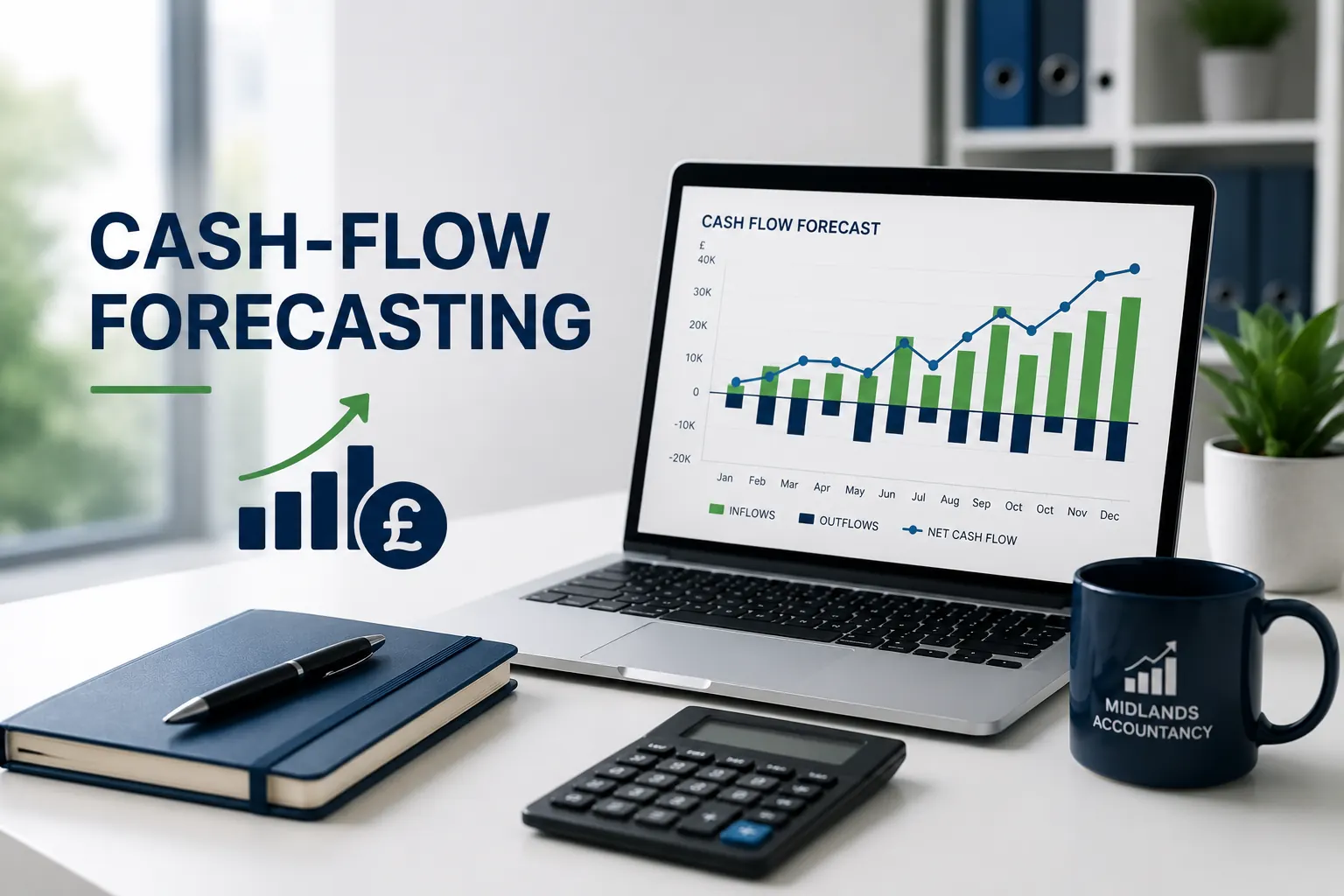
- Twelve-month forecasts to show the shape of the year and larger commitments ahead
- A clear opening cash position as the starting point everything builds from
- Realistic customer receipt timing, based on how quickly you actually get paid
- Supplier payment timing, reflecting the terms you really work to
- Payroll and tax liabilities, including VAT, PAYE and Corporation Tax, placed on the dates they fall due
- Loan and finance repayments scheduled as they leave the account
- Capital expenditure, so planned purchases are visible before they bite
- Seasonal patterns mapped so quiet periods are funded from stronger ones
- Working-capital assumptions covering stock, debtors and creditors
- Base, downside and growth scenarios so you can see the range, not just one line
- Forecast-versus-actual reviews that keep the forecast honest and rolling forward
How it works
- We start with where your cash stands today and how money genuinely moves through the business.
- We agree the scope (a 13-week view, a twelve-month view, or both) and the level of detail you need.
- We build the forecast around real receipt and payment timing rather than invoice dates.
- We add the commitments that catch people out: tax dates, loan repayments and planned purchases.
- We model base, downside and growth scenarios so the range of outcomes is visible.
- We review actual results against the forecast at agreed intervals and roll it forward so it stays live.
What we’ll need from you
To forecast cash well we need your current bank position, access to your bookkeeping or accounting software, and an honest picture of how quickly customers pay and how you pay suppliers. We also need to know about upcoming tax liabilities, loan or finance repayments, and any planned purchases or investments. If your trade is seasonal, a sense of past patterns helps a great deal. The nearer these inputs are to reality, the more dependable the forecast.
Common mistakes to avoid
- Assuming a profitable month means a comfortable bank balance
- Recording income when invoiced rather than when the money is expected to arrive
- Forgetting that VAT, PAYE and Corporation Tax fall due on their own timetable
- Overlooking loan repayments and planned purchases that draw cash out quietly
- Building only one optimistic line and testing no downside
- Treating the forecast as a one-off spreadsheet rather than keeping it live and rolling
- Ignoring seasonality, so a predictable quiet period arrives as a surprise
Serving Birmingham and the Midlands
We prepare cash flow forecasts for businesses across Birmingham and the wider Midlands, working through cloud accounting so the forecast draws on the same live figures you already rely on. That makes it straightforward to update the forecast regularly and to talk through the numbers whenever a decision or a tight month calls for it.
Frequently asked questions
I'm profitable, so why would I need a cash flow forecast?
Profit and cash are measured differently. Profit counts a sale when you invoice it; cash only arrives when the customer pays. A growing, profitable business can still be short of money if customers pay slowly, stock is bought ahead of sales, or a tax bill lands at the wrong moment. A forecast shows the cash timing that the profit figure hides.
What's the difference between a 13-week and a twelve-month forecast?
A 13-week forecast is short and detailed: it tracks the near-term movements where a squeeze would actually bite, week by week. A twelve-month forecast is broader, showing the shape of the year, seasonal peaks and troughs, and larger commitments ahead. Many businesses use both: one for immediate control, one for planning.
How often should the forecast be updated?
A forecast is most useful when it is kept live. Comparing what you forecast against what actually happened, and rolling the forecast forward regularly, keeps it accurate and shows early where assumptions are drifting. A forecast built once and left alone quickly loses its value.
Can a forecast tell me exactly what my bank balance will be?
No. It is a projection, not a guarantee. It works from assumptions about when customers pay and when costs fall due, and reality will vary. Its value is in showing the likely direction and timing well enough to act early, and in letting you test what happens if things run better or worse than expected.