

Industry hub
Hospitality Accountants in Birmingham
Hospitality accountants in Birmingham for restaurants, pubs, cafes and takeaways: daily takings, VAT, payroll, margins and year-end accounts in one place.
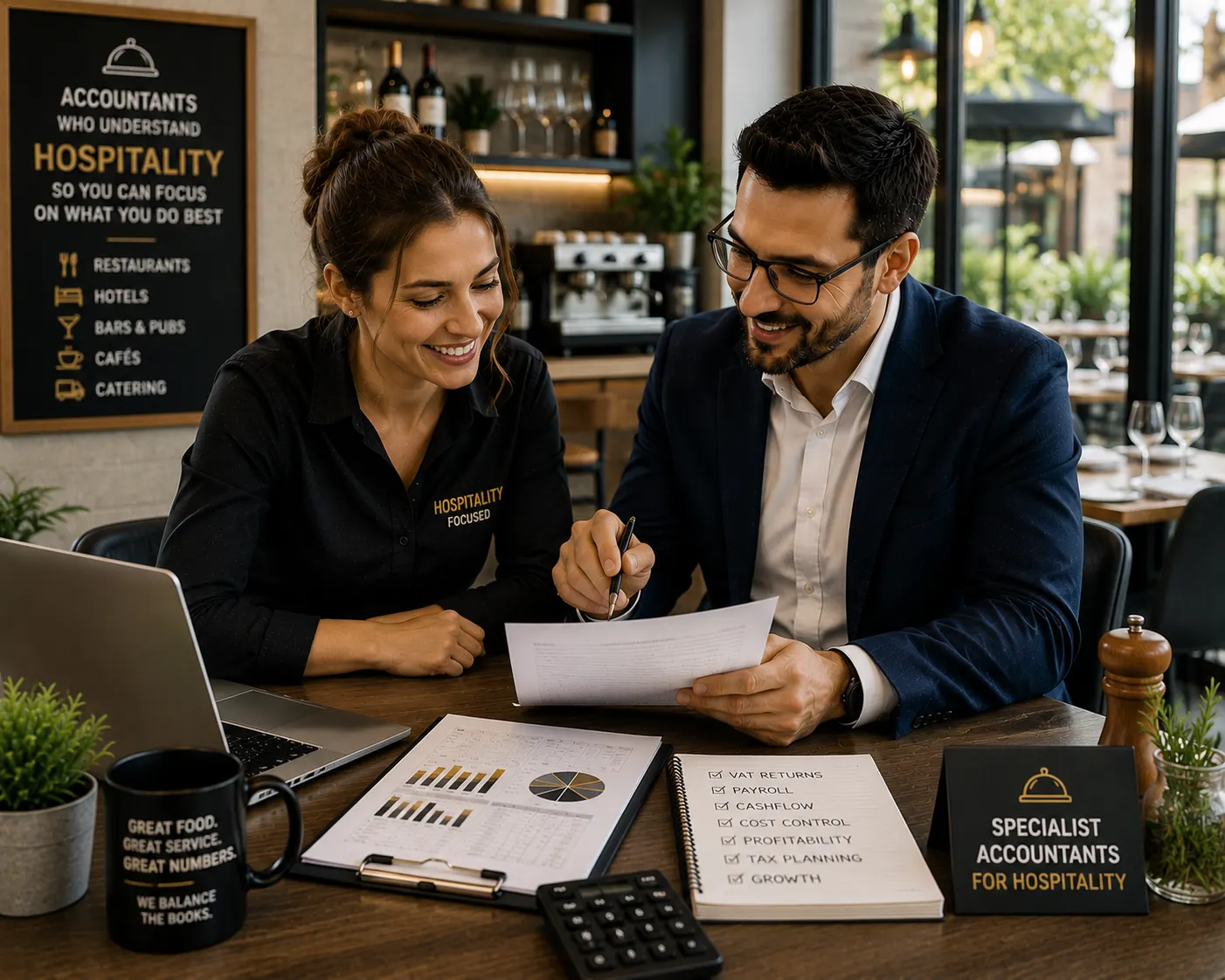
We act for restaurants, pubs, cafes and takeaways across Birmingham and the Black Country. Daily takings in, wages and stock out, and a margin that moves before anyone notices. Midlands Accountancy runs the bookkeeping, VAT and payroll behind that, and our hospitality accountants produce the monthly figures early enough for an operator to do something about them.
Restaurants, pubs, cafes and takeaways
This hub covers food and drink businesses as a whole, with a dedicated page for each trade as it is completed:
- Accountants for restaurants: independent restaurants managing food margins, delivery platforms and service payrolls.
- Accountants for pubs: freehold and tenanted pubs, wet and food-led, with their licensing and contractual layers.
Pages for cafes and takeaways are in preparation. We serve both already, so if that is you, go straight to requesting a quote.
Thin margins, daily takings and a constant cash cycle
Financially, hospitality runs on turnover. Money arrives every day through card terminals, delivery platforms and, still, some cash. It leaves almost as quickly on stock, wages, rent and utilities. Small percentage shifts in food cost or staffing swing the whole result, and seasonality means a strong December can be quietly consumed by a slow January. The sector rewards operators who track gross margin and wage percentage continuously rather than annually.
Trading structures behind the counter
Independent cafes and takeaways often begin as sole traders or family partnerships. Restaurants and pubs, with their leases, licences and staffing levels, more commonly trade as limited companies, and tenanted pub arrangements add their own contractual layer. Incorporation brings separation between the owner and the business, but also directors’ duties, company filings and payroll for the owners themselves, so the choice is worth making deliberately, usually at the point a lease or a licence is signed.
The compliance a food business carries
Most established food businesses are VAT registered, and hospitality VAT is genuinely awkward: hot and cold food, eat-in and takeaway, and delivery platform charges can each behave differently. Add payroll for a changing rota, workplace pensions, tip and tronc handling, annual accounts and a business tax return, and the administration is substantial for what are often small management teams. Deadlines arrive monthly and quarterly, not just once a year.
Till rolls, delivery statements and supplier invoices
The record set that keeps a venue safe includes daily till summaries and Z readings, card settlement reports, delivery platform statements with their commission detail, supplier invoices, staff rotas and payroll records, and a log of wastage and stock counts. Cash businesses should bank takings intact and record floats, because unexplained gaps between till records and bankings are exactly what tax inspections focus on.
What hospitality accountants do week to week
Weekly or monthly bookkeeping is the foundation, turning a stream of transactions into usable figures. On top of that sit accurate VAT returns that apply the right treatment to each sales type, payroll and auto enrolment that copes with changing rotas, and management accounts that show margin and wage costs while there is still time to act. Our guide on annual accounts versus management accounts explains why a venue needs both, and why the year-end set arrives too late to run anything by.
Cafes and takeaways, where this hub does the work
Restaurants and pubs have their own pages. Cafes and takeaways are the operators the sector’s advice usually skips, and three things catch them. Turnover creeps towards the VAT registration threshold across a busy summer with nobody adding it up, and registration is triggered by a rolling twelve-month figure rather than by the accounting year. Staffing is often part time, seasonal or family, which does not remove payroll and workplace pension duties and frequently obscures them. And these are the businesses most likely to still take real cash, so takings need banking intact and floats recording, because the difference between till and bank is the first thing anyone from HMRC will ask about.
Frequently asked questions
Is VAT different for eat-in and takeaway food?
It can be. Hot food is generally standard rated however it is sold, while some cold takeaway food is zero rated, and eat-in sales are standard rated. Delivery platform commission adds another layer. The till needs to be set up to record each sales type correctly, because the VAT return can only be as accurate as the tills feeding it.
Do delivery platform sales count towards VAT registration?
Under the usual platform arrangement the sale is still the restaurant’s own, so it counts towards taxable turnover with the platform’s commission treated as a cost. Because the contract determines whose supply it is, it is worth confirming rather than assuming. Watching combined turnover across till, card and platforms is what stops a business crossing the registration threshold unnoticed.
We run two sites under one company. Do we need separate figures?
For filing, no: one company files one set of accounts and one VAT return. For running the business, yes. Sites almost never perform alike, and a combined gross margin hides the one that is losing money inside the one that is not. Setting the tills and the bookkeeping up to report by site from the start costs nothing and is painful to retrofit.
We are months behind on the books. Where do we start?
With the bankings and the Z readings, in that order, because everything else can be rebuilt from them. Suppliers will reissue statements and platforms hold their own reports, so the gaps that cannot be recovered are usually cash ones. Our guide to catch-up bookkeeping costs sets out how the work is normally priced.
Get a quote for your venue
Our hospitality clients range across Birmingham’s dining scene and out into the Black Country and wider West Midlands: cafes, takeaways, pubs and restaurants of all sizes. Because the work runs on cloud systems fed by tills and delivery platforms, we keep figures current without adding to a service-hour workload. Request a quote and tell us how many sites you run, roughly how much of your trade goes through a platform, and whether the tills and the bank have ever been reconciled to each other.