

Industries · Subject to assessment
Accountants for Driving Instructors
Accountants for driving instructors in Birmingham and the West Midlands: franchise and independent models, lesson income records and dual-use car questions.
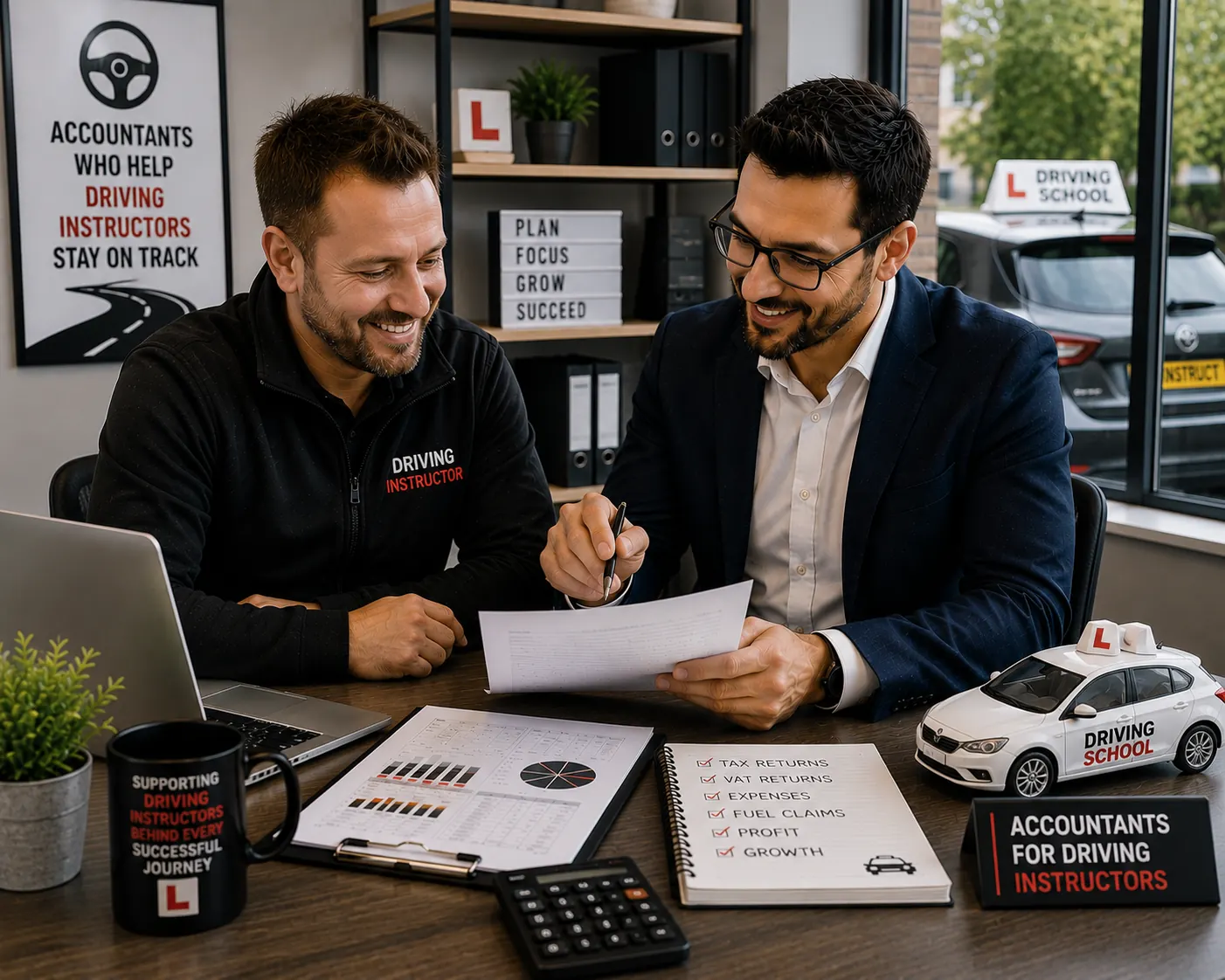
Midlands Accountancy is a Birmingham firm that acts as accountant for driving instructors across the West Midlands: approved instructors teaching learners, instructors under a national or local franchise, fully independent instructors building their own diary, and instructors growing into a small driving school. A driving instructor’s business fits inside one car, which is exactly why the accounts are trickier than they look, because the biggest cost of the business is also, for many instructors, the family car. The whole service is designed to run from your phone between lessons, and this page sits within our transport accountants hub.
Franchise or independent, and what it changes in the books
Most instructors are self-employed whichever model they choose, but the bookkeeping differs. Under a franchise, a recurring franchise fee typically covers the car, branding and pupil supply in some combination, and the records need to show lesson income gross with the franchise cost separately. Independent instructors own more of the cost stack directly and carry more of the admin. Neither model is better for tax by default, and we set up either cleanly. Instructors running a school have an extra layer: money collected for lessons delivered by others needs careful recording, and the standing of the instructors delivering them, whether they are working for you or alongside you, is worth settling before the first payment rather than after the first query.
Lesson income and how to record it
Lesson income arrives as cash in the car, bank transfers, card app payments, block bookings paid upfront and vouchers bought by parents. Every lesson taught should be traceable to a payment, and prepaid blocks need tracking as lessons are delivered against them. A simple daily habit, diary entry matched to payment received, is the backbone. HMRC’s requirements for self-employed records set the baseline, and our bookkeeping service can turn the habit into a system that runs from your phone between lessons.
One car, two uses
The tuition car is the question every instructor asks about, and the honest answer needs three pieces of information from you: how the car came to you, whether anyone drives it outside lesson hours, and roughly what share of its mileage is teaching. A dual-control car used only for lessons sits differently from a family car that also delivers them, and a franchise-supplied car is different again. There is no universal percentage and we will not pretend there is; GOV.UK’s general framing for the self-employed shows the official position. Keep a note of your mileage, be honest with us about the school run and the weekend trips, hold on to the costs with their receipts, and those figures give us the answer.
Simple bookkeeping for a teaching week
An instructor’s bookkeeping should take minutes, not evenings: record the day’s lessons and payments, photograph fuel and cost receipts, note cancellations and how they were charged, and reconcile the week once. Test fees paid on behalf of pupils, and money collected for them, need recording distinctly.
Self assessment, and what an accountant for driving instructors watches
Most instructors file a self assessment return covering their teaching profit, and instructors who also have employment income need both brought together in one return; if you are unsure whether to hand this over, our guide on whether you need an accountant for self assessment walks through it. Payments on account catch new instructors by surprise in their second year, so we forecast them in advance. Our self assessment service handles the return, and where an instructor has incorporated or is considering a company for a growing school, our business tax service covers that ground. Whether VAT ever becomes relevant depends on turnover; for most single-car instructors it does not arise, and we monitor the position. Lesson income also arrives weekly while tax bills arrive in lumps, and the leanest months, around Christmas and deep summer, are predictable, so we work out what to set aside as income comes in and give you a one-page monthly summary of income, costs and tax put by. That is usually all a single-car business needs to make the January and July dates non-events.
Mistakes instructors make with their records
Five recur, roughly in order of how much they cost. Cash lessons go unrecorded and cannot be matched back to the diary. Block bookings get counted as income twice, or never. The car is claimed on a guessed percentage with nothing behind it. Franchise fees are netted off, so turnover is understated and the accounts describe a smaller business than you run. And test fees paid on a pupil’s behalf get muddled into lesson income.
Asking us for a driving school quote
To quote we need to know whether you are franchise or independent, how pupils pay you, whether you have employment income alongside teaching, how the car is provided and used, and what records exist so far. The quote covers bookkeeping, your return, tax forecasts and the incorporation question if a school grows; our guide to what an accountant does for a sole trader gives the fuller picture of that role. Franchise contract terms, instructor registration and standards, and insurance cover are outside it. We only have room for a handful of instructor clients at a time, so ask before the autumn rush. Request a quote and tell us about your diary.
Frequently asked questions
I get paid mostly in cash. Is that a problem for my accounts?
Cash is fine; unrecorded cash is the problem. A daily record matching lessons to payments makes cash income as solid in your accounts as bank transfers, and it protects you if your figures are ever questioned.
How do block bookings work in my records?
Money received upfront for a block is tracked against the lessons you then deliver, so at any point you can see lessons owed and income earned. Treating the whole block as earned on day one distorts your figures and makes refunds messy.
Can I claim my car against tax?
Send us the paperwork on the car and tell us honestly how much of its mileage is not teaching. That figure, plus how the car came to you, drives the answer. There is no standard percentage that fits every instructor, and anyone who gives you one has not asked enough questions.
I teach evenings alongside an employed day job. Do I still need to file a return?
Almost certainly yes, since self-employed teaching income sits alongside your employment income in one self assessment return. We bring both together and make sure tax already paid through your employment is properly reflected.