

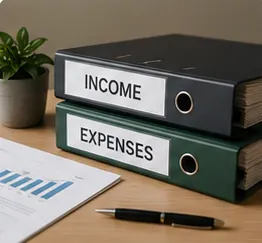
What a landlord hands to an accountant decides how the engagement goes. A complete pack, organised per property, turns the tax return into checking and computation. A partial pack turns it into correspondence: a chain of query emails, each waiting on a bank, an agent or your memory. This guide sets out how to prepare your property income records for that handover: the pack itself, the extras joint owners must add, and the gaps that generate the most queries.
The return this all feeds is the property section of Self Assessment, and your obligations as a landlord are summarised on the GOV.UK page about renting out a property. For a growing number of landlords it is no longer the only thing the pack feeds. Making Tax Digital for Income Tax is being phased in for landlords and the self employed, and above the qualifying income level HMRC has set for your year you must keep records digitally in compatible software and send quarterly updates alongside the year end return. Check the current dates and income levels on GOV.UK, because the phasing runs across several tax years. If that applies to you, agree with your accountant before the tax year starts who is entering what and when, because a handover designed around one annual deadline will not survive four more.
What property income records does an accountant need?
For each property, one bundle containing:
- Rent received for the year, with dates, and a note of arrears or rent-free periods
- Every cost invoice and receipt, whatever you think its treatment might be
- Letting agent statements for all twelve months
- Mortgage or loan statements showing the year’s interest
- Deposit movements: anything taken, returned or retained, with paperwork
- Tenancy changes: new lets, renewals, endings, and any void periods
- A short note of anything unusual: an insurance claim, a dispute, a change of use
Hand over cost paperwork even where you doubt its relevance. Treatment depends on the facts of each item, and the accountant can only judge items they can see. The year-round filing habit that makes this pack a ten-minute job is our landlord accounting records checklist.
Jointly owned property: the extra layer
Joint ownership is where otherwise tidy handovers fall apart. Your accountant needs to know, for each jointly owned property: who the legal owners are, in what shares the property is held, whether any formal declarations or arrangements about income shares exist, and how the owners actually split the money in practice. Spouses and unmarried co-owners are treated differently by the tax rules, and defaults apply where nothing formal exists, so the paperwork, or its confirmed absence, changes the returns of everyone involved. Each owner files their own return, and the accountant must prepare the owners’ figures consistently, which is impossible if only one owner’s version of the arrangement is on file.
First year with this accountant? Add the history
A new accountant also needs your prior context: last year’s tax return, details of when each property was first let, purchase completion statements, and records of major works since purchase. Purchase and improvement paperwork matters for as long as you own the property, because it feeds the calculation when you eventually sell. Handing history over once, at the start, means it is on file for every future event.
The gaps that generate the most queries
- A missing agent statement for precisely the month a tenancy ended
- Interest figures guessed from mortgage payments instead of taken from statements
- Cash-paid repairs with no invoice and a vague date
- A retained deposit that appears in the bank but nowhere in the records
- Joint ownership “understood” differently by each owner
- Personal and rental transactions interleaved in the same account with no marking
None of these are fatal, but each one converts minutes into weeks, because the fix depends on third parties. Handing records over soon after the tax year ends leaves slack for that; a deadline-week handover does not.
When the handover should become continuous
If assembling the pack takes longer each year, or the portfolio has grown past a handful of properties, the answer is usually to stop assembling annually and keep books monthly, either yourself or through our bookkeeping service. Landlords already sending quarterly updates have had that decision taken for them: figures due four times a year cannot be reconstructed once a year. The portfolio-scale version of that discipline is described in bookkeeping for rental property businesses, and the effect of records on your fee, in either direction, in what drives a landlord accountant’s cost.
Frequently asked questions
When should I send my accountant my property records?
Shortly after the tax year ends, not near the filing deadline. Early handover means gaps get fixed calmly, you learn any tax due months ahead, and your accountant’s queries reach you while the year is still fresh.
What should I tell my accountant about a property that stood empty?
The void dates, why it was empty, what you spent during the void and whether you were seeking tenants. The treatment of void-period costs depends on those facts, so the narrative matters as much as the invoices.
Do I need to hand over records for a property that made a loss?
Yes, in full. Losses have to be established by records just like profits, and properly evidenced losses can matter to your position in later years. An undocumented loss helps nobody.
My co-owner uses a different accountant. What happens?
Both accountants need the same ownership facts and must report consistent shares. Agree the documented position between owners first, then give both accountants the same paperwork; conflicting returns between co-owners are an avoidable enquiry trigger.
How we can help
Our support for landlords starts with a records review and a handover list tailored to your properties. Request a quote and we will tell you exactly what to send.