

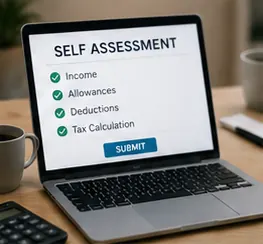
To prepare for Self Assessment, a childminder needs four bundles of records: a complete income figure covering parent fees, funding and voucher payments; totalled business expenses with the receipts behind them; evidence of minding hours to support any home running cost claim; and details of any other personal income, because the return covers your whole tax position, not just the childminding. Assemble those soon after the tax year ends and filing is straightforward. Leave it until the deadline looms and every gap becomes urgent.
Filing deadlines exist and carry penalties; the current dates are on the GOV.UK overview of Self Assessment tax returns. The gap-fixing time is the real reason to start early, not the date itself.
First returns: registration comes before records
If this is your first year of minding, you must register for Self Assessment before you can file at all, and registration has its own deadline. New childminders regularly discover this late. If you have not registered, do that first, then return to the gathering exercise.
Check whether Making Tax Digital applies to you
Making Tax Digital for Income Tax is now being phased in for self-employed people. If your qualifying income is above the level HMRC has set for the year in question, you keep your records digitally in compatible software and send quarterly updates during the year as well as a year end return, which turns this gathering exercise from an annual job into a quarterly one. Qualifying income is measured before expenses, so it is a larger figure than your profit. The dates and income levels are published on GOV.UK and change across several tax years, so check where you sit before planning the year.
Bundle one: the complete income picture
Your income figure must capture every source for the tax year:
- Parent fee invoices and a record of what was actually received
- Local authority funding payments, broken down by child and term
- Childcare voucher and tax-free childcare receipts
- Retainers, deposits kept, and charges for extras such as meals or late collection
Cross-check the total against bank credits for the year. If cash was received, your own daily record is the evidence, which is why the habits in the childminder bookkeeping records checklist matter long before return season.
Bundle two: expenses with their receipts
Total your business spending by category: equipment and toys, food for minded children, craft materials, outings, insurance, registration, training, travel. Which items reduce your tax, and by how much, depends on your facts, and that judgement belongs in the return preparation conversation rather than a generic list. Your job at the gathering stage is completeness: every cost recorded, every receipt kept, as the GOV.UK guidance on keeping your pay and tax records requires.
Bundle three: hours and home evidence
Claims relating to working from home rest on evidence of your minding hours and household costs. Pull together your attendance-based hours for the year and the household bills you have retained. Which route the calculation takes matters as much as the totals. HMRC publishes an arrangement specific to childminders that sets out proportions of household running and fixed costs claimable by the hours you mind, plus an allowance for wear and tear of furniture and household items, but HMRC has confirmed it is not available to childminders who are inside Making Tax Digital, who follow the ordinary business rules on expenses and records instead. Check your position on GOV.UK rather than assuming which route applies, and bring the bills and the hours record to the preparer either way.
Bundle four: the rest of your tax life
The return needs your whole position: employment income from any other job, your partner’s relevant details where claims interact, bank interest, pension contributions, child benefit in the household, and student loan status. Missing personal items are the most common reason a “finished” childminder return cannot actually be filed.
Gaps in childminder Self Assessment records that stall filing
- Funding remittances never broken down, leaving the income figure unprovable
- A missing month of bank statements from a switched account
- Cash income remembered but never recorded
- No note of minding hours, weakening the home-cost position
- Forgotten personal income, discovered after the computation was done
Most gaps are fixable, but fixing takes weeks when banks and funding bodies are involved. That is the argument for gathering in the spring rather than the winter.
Doing the return yourself or handing it over
A childminder with one income stream and tidy records can self-file with care. Multiple funding schemes, a first return, an assistant on the payroll or a backlog year all strengthen the case for help, and the price of that help depends mostly on factors you control, as we explain in what drives a childminder accountant’s cost. Our Self Assessment service works from exactly the bundles described above.
Frequently asked questions
When should a childminder start preparing their tax return?
As soon as practical after the tax year ends. Early preparation reveals gaps while they are still fixable, tells you any tax due months in advance, and removes the deadline scramble entirely.
What if I have lost receipts for things I definitely bought?
Tell your preparer rather than silently dropping or guessing the figures. Bank records, supplier reprints and reasonable reconstruction can often support the position, but that is a judgement to make openly.
Do I need to send my attendance registers to HMRC with the return?
No. The return reports figures, not documents. You keep the registers and receipts as the evidence behind the figures, ready to produce if HMRC ever asks.
I minded for only part of the year. Do I still complete a return?
If you were trading as self-employed at any point in the tax year and meet the criteria on GOV.UK, yes, covering the period you traded. Part-year records are gathered exactly the same way, just for a shorter span.
How we can help
Our support for childminders includes return preparation from your records, with a checklist tailored to your income sources. Request a quote and we will tell you exactly what to gather.